Biomanglar: How Colombia’s Communities are Restoring Mangroves for People and Planet

A bold community-driven effort unites local people, biodiversity and sustainable livelihoods through mangrove conservation and restoration.
Mangrove forests are some of the most productive and biologically rich ecosystems on Earth. Along tropical and subtropical coastlines, these tangled forests of salt-tolerant trees support vast networks of life, provide natural protection from storms, and capture and store carbon that helps slow climate change. But mangroves face mounting pressures from coastal development, resource extraction, pollution and climate change. In response, visionary conservation efforts are needed now more than ever not only to protect biodiversity but also to safeguard the people and cultures that depend on these dynamic coastal landscapes. One such initiative making waves is Biomanglar, a project supported by the Global Biodiversity Framework Fund (GBFF) and implemented in Colombia to empower local Afro-Colombian communities to lead mangrove conservation and restoration across the Pacific coast.
What is Biomanglar
Biomanglar is a community-centred biodiversity and restoration project in the Pacific regions of Chocó, Valle del Cauca, Cauca and Nariño in Colombia. It is part of the broader efforts under the GBFF, a global financing mechanism designed to help countries implement the Kunming-Montreal Global Biodiversity Framework and achieve measurable biodiversity outcomes.
What sets Biomanglar apart from many conservation initiatives is its emphasis on local leadership, cultural heritage and community governance. The project places Afro-Colombian collective territories areas where Black communities have lived for generations and have long cared for the mangrove ecosystems at the centre of conservation actions. Biomanglar’s strategy champions community rights and acknowledges the deep traditional knowledge these coastal peoples hold regarding mangrove ecology and sustainable use.
Rather than imposing external management, Biomanglar supports communities to strengthen governance systems, expand inclusive decision-making and lead restoration work on their own terms. This approach aligns with global calls to ensure Indigenous Peoples and local communities are front and centre in biodiversity action, recognising that ecological protection and human wellbeing are intertwined.
Mangroves Matter for People and Planet
Mangrove forests hold immense ecological and social value. Their complex root systems create nurseries for fish and crustaceans, stabilise shorelines, buffer coastal communities from storm surges and flooding, and store large amounts of carbon beneath the soil and biomass. This capacity to sequester “blue carbon” makes mangroves a powerful nature-based solution for climate mitigation.
Beyond their environmental functions, mangroves are deeply connected to local ways of life in Colombia’s Pacific coast. Afro Colombian communities rely on mangrove ecosystems for artisanal fishing, harvesting of molluscs like piangua, and cultural practices tied to coastal waters. The loss of mangroves therefore not only degrades biodiversity but threatens livelihoods, food security and cultural continuity.
Global loss of mangrove forests has been significant, with estimates suggesting that at least a third of mangrove area has vanished due to conversion to aquaculture, infrastructure development, agriculture and other human pressures. This ongoing decline underscores the urgency of restoration and sustainable management.
Goals and Impact of the Biomanglar Project
The Biomanglar initiative is designed to produce both ecological and social benefits by blending restoration efforts with community empowerment. Key goals include:
Restoring Degraded Mangrove Landscapes
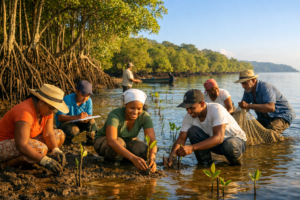
Biomanglar plans to restore hundreds of hectares of degraded mangrove forest. Restored mangroves rebuild habitat for wildlife, enhance carbon storage, and improve coastal resilience to climate impacts such as sea level rise and storm surges.
Strengthening Governance and Local Leadership
A core element of the project is strengthening local governance systems. This means supporting Afro-Colombian communities to organise, plan and make decisions about the use and protection of their territories. It includes leadership development, inclusive governance frameworks, and mechanisms that allow all community members especially women and youth to participate meaningfully in management decisions.
Advancing Gender Equity and Youth Engagement
Biomanglar places a strong focus on gender equality and youth leadership. By prioritising opportunities for women and young people, the project aims to ensure that conservation and restoration work reflects diverse voices and creates benefits across generations.
Integrating Traditional Knowledge and Science
Another hallmark of Biomanglar is the integration of traditional ecological knowledge with modern conservation techniques. This helps to ensure that restoration and monitoring practices are rooted in local understanding of ecosystems while also drawing on scientific tools such as blue carbon assessments to measure impact.
Promoting Sustainable Livelihoods
Biomanglar supports livelihood strategies that are compatible with healthy mangrove ecosystems. These include sustainable fisheries, responsible harvesting of mangrove-related products and nature-based tourism. Such approaches diversify income sources for local communities while maintaining ecological integrity.
Why Community Led Conservation Works
Traditional top down conservation approaches have often failed to produce lasting ecological benefits or secure the wellbeing of local people. Community-led programs like Biomanglar offer an alternative that respects cultural relationships with land and sea, increases local ownership of conservation outcomes, and builds resilience by enhancing local capacity.
By placing communities at the heart of decision-making, Biomanglar aligns ecological goals with human development objectives. This integrated perspective recognises that biodiversity cannot be protected in isolation from the people who depend on it a principle that is also central to the design of the GBFF and global biodiversity strategies more broadly.
The Broader Context of Global Biodiversity Funding
The Global Biodiversity Framework Fund was established to provide targeted finance to implement international biodiversity goals. Ratified by nearly 190 countries, the fund aims to strengthen national biodiversity planning, governance and sustainable finance approaches. Through projects like Biomanglar, the GBFF is testing innovative models that scale up local action toward global targets.
Projects funded by GBFF often prioritise inclusion of Indigenous Peoples and local communities, gender equality, and measurable biodiversity and livelihood outcomes. Biomanglar exemplifies this ethos, combining habitat restoration with social equity and economic opportunities, all rooted in local cultural heritage.
Looking Ahead: Long Term Benefits
As Biomanglar progresses, the project is expected to generate measurable benefits for ecosystems and people alike. Improved mangrove health will translate into stronger coastal resilience, richer biodiversity and expanded carbon sequestration. Communities will gain enhanced governance structures, diversified livelihoods and expanded opportunities for women and youth.
Visible results from programs like Biomanglar can inspire similar efforts elsewhere, demonstrating that community knowledge and leadership are indispensable to effective conservation. By marrying tradition and innovation, local tradition and global support, Biomanglar points toward a model of conservation where nature and people thrive together.